
Description


Full trailer
The full trailer, also widely known as a drawbar trailer, is a self-supported heavy transport unit featuring a complete independent running gear and axle load-bearing system. Unlike semi-trailer configurations, the full trailer carries 100% of its cargo weight on its own axles — the towing tractor is responsible solely for providing traction force, with zero vertical load transfer at the coupling point. This fundamental design principle delivers superior structural efficiency, as the tractor’s full power output is directed toward propulsion rather than supporting trailer mass.
Based on differences in appearance and functions, full trailers are mainly classified into the following types.
- Dolly draw bar trailer
- Skeleton draw bar trailer:
- Flatbed draw bar trailer:
- Low bed draw bar trailer
- Dropside draw bar trailer
- Fence draw bar trailer
- Log draw bar trailer
- Dump draw bar trailer
- Tank draw bar trailer
- Other type of draw bar trailer
The trailer is connected to the prime mover through a robust drawbar assembly equipped with a standardized towing eye (2-inch diameter), compatible with Rockinger bell mouth couplers and other internationally recognized coupling systems. The drawbar incorporates a multi-directional articulation joint, allowing flexible angular movement during cornering and maneuvering while maintaining stable longitudinal force transmission. The front axle assembly is fitted with a heavy-duty rotating turntable, enabling responsive steering articulation and accommodating tight turning radii in constrained operational environments.
Engineered with a high-strength steel frame structure — utilizing Q345-grade steel and submerged arc welding (SAW) processes — the full trailer delivers exceptional load-bearing capacity with a proven track record of low maintenance requirements and high operational uptime. The rigid chassis architecture ensures uniform load distribution across all axle lines, minimizing localized stress concentration and extending component service life. The design supports high payload-to-tare-weight ratios, making it particularly well suited for the transportation of bulk cargo, grain, powdered materials, containerized cargo, and liquid tank transport loads.
The full trailer demonstrates excellent trafficability and route flexibility, performing reliably across diverse terrain conditions including unpaved rural roads, mining haul routes, and long-distance freight corridors — particularly in regions such as Africa, Southeast Asia, and South America where road infrastructure varies significantly. Its independent parking capability allows the unit to stand stably on its own axles after decoupling, eliminating the need for auxiliary support legs and streamlining drop-and-hook logistics operations. The combination delivers smooth ride quality with good flexibility, adapting well to abnormal load transport scenarios and heavy haul applications.
All configurations — including overall dimensions, axle count, suspension type (mechanical leaf spring, air suspension, or bogie suspension), braking system, and payload rating — can be tailored to comply with the road transport regulations and dimensional restrictions of the destination country. The trailer supports multiple body configurations including flatbed, side wall, skeletal, tanker, and dumper variants, ensuring seamless integration into local transport fleets and full regulatory compliance upon delivery.
- Zero vertical load on tractor — maximizes traction efficiency and reduces prime mover wear
- Independent standing capability — enables efficient drop-and-hook operations without ground support equipment
- Universal coupling compatibility — 2-inch towing eye interfaces with standard tractor and forklift couplers, including Rockinger bell mouth assemblies
- High payload capacity — optimized for bulk, container, and tank transport applications
- Low maintenance cost — simplified mechanical design with widely available spare parts
- Terrain adaptability — proven performance on rural roads, mining sites, and long-haul routes
- Fully customizable — dimensions, axle configurations, suspension types, and body styles adapted to local road regulations
- Stable high-speed operation — reliable performance at speeds up to 70 km/h with excellent directional stability
| Item | specifications | Remark |
|---|---|---|
| Material | High strength Carbon steel T700 or manganese steel Q345B | |
| Turn table | With one steerable | |
| Draw bar eyes | 2”/3.5” | Main beam H beam beam extendable optional |
| Axles | 11.5ton,13 ton(16ton,20ton) capacity | FUWA,BPW,AN,CTC or GT Brand |
| Suspension | Mechanical suspension | Air suspension optional |
| Leaf spring | Leaf spring | Air bag lifting optional |
| Tire | 11R22.5 ,12R22.5 ,315/80R22.5,385/65R225 | Other size and brand optional |
| Platform | Checked plate 3mm | Other thickness optional |
| Side beam | 140mm or 160mm |
| Twist locks | Optional |
| Braking system | Dual line brake system,Double air chamber ,brake valve,40L air tanks ;ABS optional |
| Electrical | LED light , 7 ways ,24V |
| Painting | Blasting and clean rust,1 coat of prime painting ,2 coat of finish painting |
| Accessory | Tool box,oil tank,spraying system optional |
Above date can be customized per your local regulation and requirement.
Like semi-trailers, full trailers are classified into various types according to different application scenarios and superstructure designs.


The dolly drawbar trailer is a specialized conversion configuration that enables a standard semi-trailer to operate in full trailer / drawbar trailer towing mode. By mounting a converter dolly — a compact axle assembly equipped with a fifth wheel — beneath the front section of a semi-trailer, the semi-trailer’s kingpin is coupled to the dolly’s fifth wheel, effectively transforming the entire combination into a self-supported full trailer that can be towed by a conventional truck or tractor via a drawbar coupling, without requiring a dedicated semi-trailer tractor with a fifth wheel.
How It Works
In standard semi-trailer operation, the front portion of the trailer rests on the tractor’s fifth wheel, transferring a significant portion of the cargo weight (typically 20%–30%) as vertical load onto the prime mover. The dolly conversion eliminates this arrangement entirely. The converter dolly is positioned under the semi-trailer’s kingpin area, the kingpin locks into the dolly’s fifth wheel, and the dolly’s A-frame drawbar extends forward to connect to the towing vehicle via a pintle hook or towing eye. Once coupled, 100% of the cargo load is borne by the combined axle groups of the dolly and the semi-trailer — the towing vehicle provides traction force only, with zero vertical load transfer.
Dolly Types
A-Dolly (Single Drawbar) — Features a single centrally mounted drawbar with one coupling point. Simpler in design, lighter in weight, and widely used in standard conversion applications. The A-frame drawbar connects to the towing vehicle’s pintle hook, providing stable longitudinal force transmission.


The skeleton drawbar trailer is a purpose-built full trailer engineered exclusively for ISO container transport. Featuring a minimalist open-frame chassis with integrated twistlock locking points, it maximizes payload capacity while ensuring secure container fixation during transit.
Chassis & Twistlock System
Constructed from high-strength steel (Q345B) with an optimized I-beam cross-section for exceptional torsional rigidity at minimal tare weight. The deck is fitted with retractable twistlocks (8-lock or 12-lock) positioned to ISO container corner casting standards, featuring a 90° rotational locking mechanism for rapid and secure container locking without additional lashing equipment.
Dimensions & Suspension
The standard configuration is the 20ft skeleton drawbar trailer for single 20-foot ISO containers. 40ft and custom lengths are available upon request. Suspension options include leaf spring mechanical suspension, air suspension, and bogie suspension to match road conditions and payload requirements. Axle configurations range from 2-axle to 4-axle layouts with FUWA, BPW, or GT brand axles.
Coupling & Steering
As a full trailer, it carries 100% of the container load on its own axles with zero vertical load on the tractor. The A-frame drawbar connects via a standardized towing eye and pintle hook, with a front turntable for responsive steering articulation and independent parking.
Applications & Customization
Widely deployed in container transport, port logistics, and intermodal freight operations — particularly in Africa, Southeast Asia, South America, and the Middle East. All specifications — dimensions, axle count, suspension type, braking system, twistlock configuration, and tire selection — can be tailored to comply with local road transport regulations.


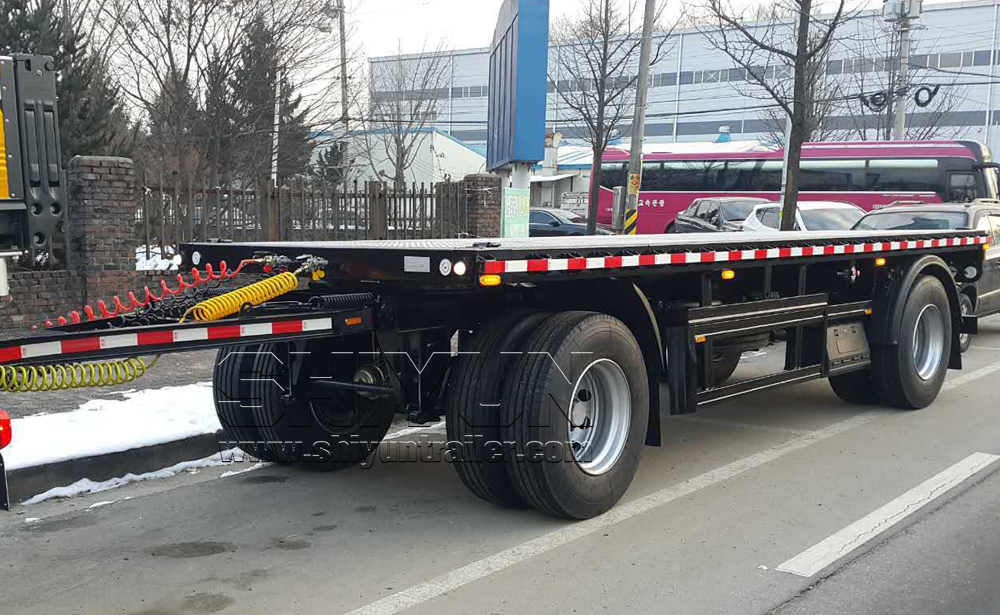
The flatbed drawbar trailer is a versatile full trailer configuration featuring an open flat deck platform, designed for the transportation of 20ft and 40ft ISO containers, bulk cargo, steel structures, machinery, and general freight. Unlike the skeleton variant, the flatbed drawbar trailer provides a solid continuous deck surface, making it suitable for both
containerized and non-containerized cargo — offering broader application flexibility.
Chassis & Deck Design
The chassis is constructed from high-strength steel main beams with an optimized cross-section for maximum torsional rigidity and load-bearing capacity at minimal tare weight. The flat deck is reinforced with closely spaced cross-members to withstand forklift loading and heavy point loads. Retractable twistlocks can be integrated into the deck for secure container fixation when required, providing dual functionality for both container and general cargo transport.
Dimensions & Suspension
Standard lengths are available for 20ft and 40ft container configurations, with custom lengths available upon request to meet specific cargo and regional road requirements. Suspension options include leaf spring mechanical suspension, air suspension, and bogie suspension to match varying road conditions and payload demands. Axle configurations and tire specifications are fully customizable.
Coupling & Steering
As a full trailer, it carries 100% of the cargo load on its own axles with zero vertical load on the tractor. The A-frame drawbar connects to the prime mover via a standardized towing eye and pintle hook, with a front turntable for responsive steering articulation and independent parking.
Applications & Customization
Widely used in container transport, bulk cargo haulage, construction material delivery, mining logistics, and regional distribution — particularly in markets across Africa, Southeast Asia, South America, and the Middle East. All specifications — dimensions, axle count, suspension type, braking system, twistlock configuration, and tire selection — can be tailored to comply with local road transport regulations.


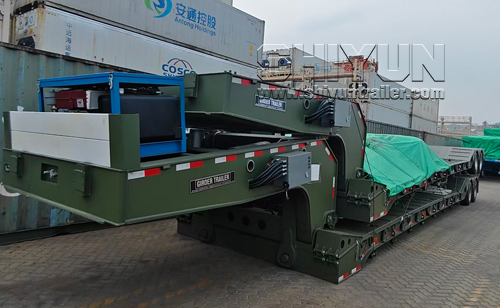
The low bed drawbar trailer, also known as a lowboy full trailer, is a specialized full trailer configuration featuring a significantly lowered deck height, designed for the transportation of construction equipment, heavy machinery, and oversized cargo. Equipped with rear loading ramps, it allows excavators, bulldozers, loaders, and other tracked or wheeled equipment to drive on and off the deck directly — eliminating the need for cranes or external lifting equipment.
Chassis & Deck Design
The chassis adopts a stepped / concave-beam frame structure — with a raised front section connecting to the drawbar and a lowered main deck area — to achieve a minimal loading deck height while maintaining structural integrity. The main beams are constructed from high-strength steel (Q345B or equivalent) with an optimized cross-section for exceptional load-bearing capacity and torsional rigidity. The low center of gravity ensures superior transport stability and
enhanced safety when carrying tall or top-heavy loads.
Loading Ramp System
The trailer is equipped with rear hydraulic or mechanical loading ramps, enabling self-propelled equipment to drive onto the deck with ease. Ramp options include:
Hydraulic ramps — Power-operated for fast and effortless deployment, ideal for frequent loading and unloading operations
Mechanical spring ramps — Cost-effective and reliable, suitable for standard construction equipment transport
Ramp width and angle can be customized to accommodate various equipment track widths and approach angles.
Dimensions & Suspension
Standard configurations are available in multiple deck lengths to suit different equipment sizes, with custom lengths available upon request. Suspension options include leaf spring mechanical suspension, air suspension, and bogie suspension to match road conditions and payload requirements. Axle configurations range from 2-axle to 4-axle layouts with FUWA, BPW, or GT brand axles. Tire specifications are fully customizable based on regional road conditions and load ratings.
Coupling & Steering
As a full trailer, it carries 100% of the cargo load on its own axles with zero vertical load on the tractor. The A-frame drawbar connects via a standardized towing eye and pintle hook, with a front turntable for responsive steering articulation and independent parking.
Applications & Customization
Widely deployed in construction equipment transport, mining logistics, heavy machinery relocation, and project cargo haulage — particularly in markets across Africa, Southeast Asia, South America, and the Middle East. The low bed drawbar trailer also supports container transport with optional twistlock fittings, offering dual-purpose flexibility. All specifications — dimensions, axle count, suspension type, braking system, ramp configuration, and tire selection — can be tailored to comply with local road transport regulations.


The dropside drawbar trailer, also known as a side wall cargo full trailer, is a versatile full trailer configuration built upon the flatbed drawbar trailer platform with the addition of detachable side walls. This modular design retains the open flat deck of the flatbed variant while adding enclosed cargo containment — enabling rapid conversion between side wall mode for general freight and flatbed mode for oversized or irregular loads.
Chassis & Side Wall Design
The chassis is constructed from high-strength steel (Q345B) with an optimized I-beam cross-section, sharing the same robust flatbed platform as the flatbed drawbar trailer. The detachable side walls are mounted on hinge pins and secured with quick-release latches, allowing operators to fold down or remove individual panels for side-loading access or convert the trailer back to a standard flatbed configuration. Side wall heights are customizable to suit specific cargo types and regional regulations.
Dimensions & Suspension
Available in 2-axle, 3-axle, and 4-axle configurations with FUWA, BPW, or YORK brand axles. Suspension options include
leaf spring mechanical suspension, air suspension, and bogie suspension to match road conditions and payload demands. Tire specifications are fully customizable based on regional requirements.
Twistlock & Container Capability
Optional retractable twistlocks can be integrated into the deck, enabling the trailer to securely carry 20ft and 40ft ISO containers — providing dual-purpose functionality for both general cargo and containerized freight, consistent with the flatbed drawbar trailer’s versatility.
Coupling & Steering
As a full trailer, it carries 100% of the cargo load on its own axles with zero vertical load on the tractor. The A-frame drawbar connects via a standardized towing eye and pintle hook, with a front turntable for responsive steering articulation and independent parking.
Applications & Customization
Widely used in general cargo transport, agricultural haulage, construction material delivery, container transport, and regional distribution — particularly in Africa, Southeast Asia, South America, and the Middle East. All specifications — dimensions, axle count, suspension type, side wall height, braking system, twistlock configuration, and tire selection — can be tailored to comply with local road transport regulations.


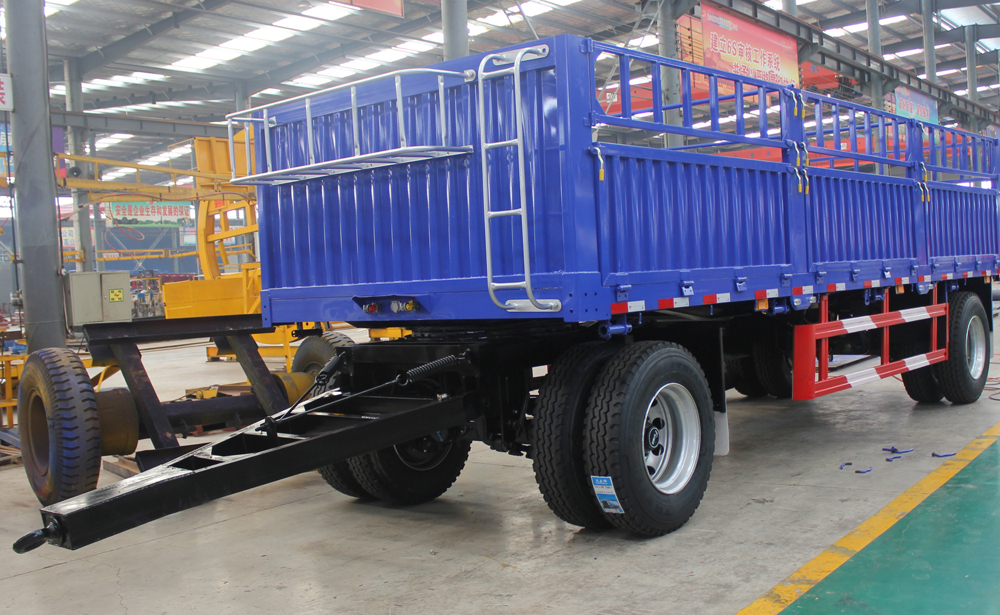
The fence drawbar trailer, also known as a high side fence full trailer or cage full trailer, is a versatile full trailer configuration built upon the dropside drawbar trailer platform with the addition of flower basket rails (stake-style vertical rails) above the side walls. The higher side panels provide greater cargo containment volume, making it ideal for transporting bulky cargo, agricultural products, and loose materials that require full enclosure to prevent spillage during transit.


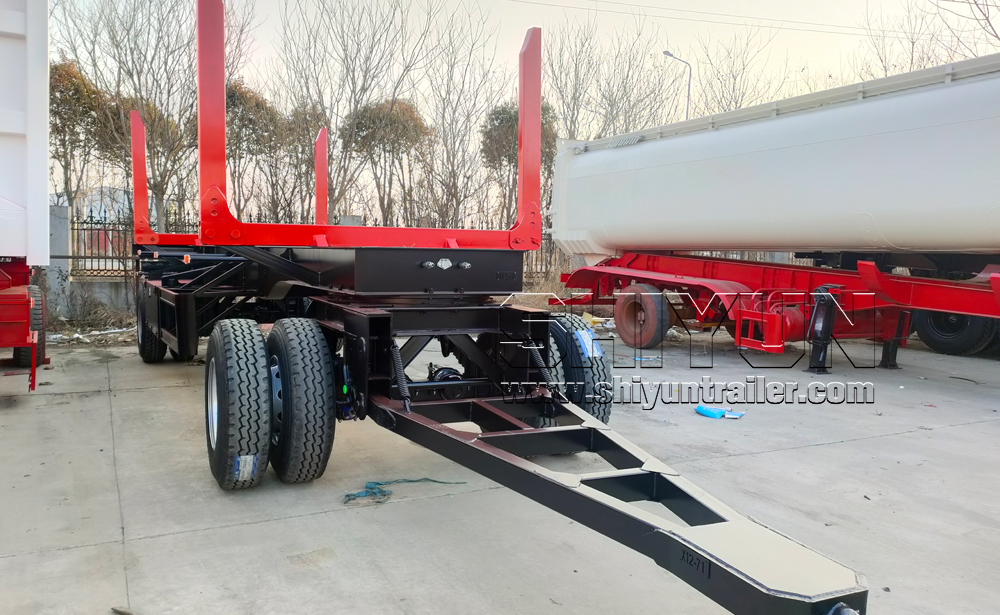
The log transport full trailer, also known as a timber full trailer, is a purpose-built full trailer configuration specially designed for the transportation of logs, timber, and wood products. Equipped with log brackets (bunks) mounted on the frame, it provides secure and stable fixation of logs during transit, preventing lateral shifting and ensuring safe haulage on forest roads, rural routes, and highways.
Frame & Log Bracket System
The chassis is constructed from high-strength steel (Q345B or equivalent) with a reinforced frame structure designed to withstand the concentrated point loads and dynamic forces generated by heavy timber cargo. The log brackets are installed at optimized spacing along the frame to cradle logs firmly, with adjustable bracket positions available to accommodate varying log lengths and diameters. The bracket design features a curved or stepped profile to prevent log roll-off during loading, transit, and unloading.
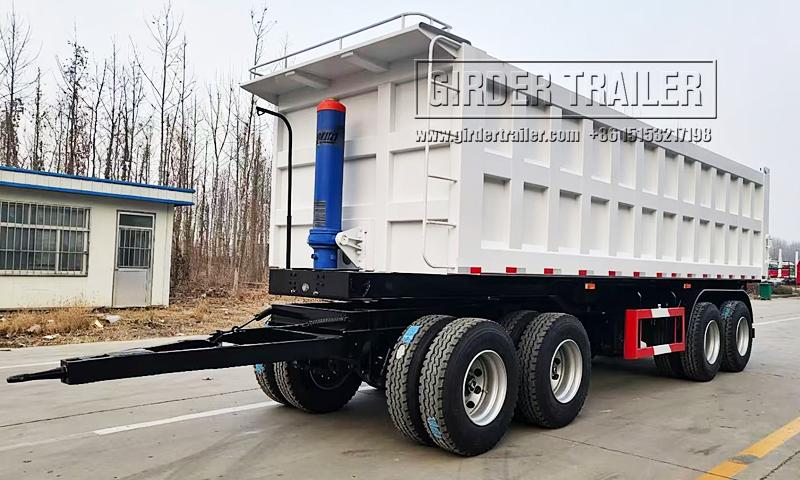
The tipper draw bar full trailer is equipped with an integrated hydraulic tipping system to lift the cargo body for fast automatic unloading. It adopts rear-tipping or side-tipping structure for high unloading speed and working efficiency.
The cargo body is thickened and reinforced with wear and impact resistance, suitable for bulk materials such as sand, gravel, muck, ore and grain.


The dump drawbar trailer, also known as a tipper drawbar full trailer, is a heavy-duty full trailer configuration equipped with an integrated hydraulic tipping system for fast and efficient automatic unloading. Designed for the transportation of bulk materials such as sand, gravel, muck, ore, and grain, it delivers high unloading speed and operational efficiency in construction, mining, and agricultural applications.
Cargo Body & Tipping System
The cargo body is constructed from thickened, reinforced steel with enhanced wear resistance and impact resistance, engineered to withstand the abrasive and heavy-load conditions typical of bulk material haulage. The integrated hydraulic tipping system provides reliable and rapid lifting of the cargo body for gravity-assisted unloading. Two tipping configurations are available:
Rear-tipping — Standard configuration, ideal for general bulk material discharge with controlled directional unloading
Side-tipping — Enables faster discharge over a wider area, preferred for high-volume operations and site-leveling applications


The tank drawbar trailer, also known as a drawbar tanker, is a purpose-built full trailer configuration specially designed for the transportation of liquid goods — including flammable liquids, explosive liquids, and general-purpose liquid cargo. The sealed cylindrical tank body ensures safe containment and prevents leakage during transit, making it an ideal solution for fuel distribution, chemical transport, water supply, and agricultural liquid haulage.
Tank Body Design
The tank body is constructed from high-strength steel (or stainless steel / aluminum alloy upon request) with a reinforced cylindrical or elliptical cross-section for optimal structural integrity and load distribution. The interior features anti-surge baffles to minimize liquid sloshing during acceleration, braking, and cornering, enhancing transport stability. The tank is equipped with standardized manholes, discharge valves, and filling ports, with optional features including heating systems, insulation layers, and vapor recovery systems depending on the cargo type.
Reviews
There are no reviews yet.